
Thursday, September 27, 2018

Ministries have not provided information required under federal RTI law: study

— File Photo 

ISLAMABAD: Federal ministries have not provided 39 categories of information required under the 2017 Federal Right of Access to Information Act, 17 ministries have not set up websites and 29 have performed poorly in complying with the proactive disclosure clause, a study revealed on Wednesday.
A study titled Impeding Transparency, Accountability and Access to Information: Inactive Government on Proactive Disclosure was conducted by the Institute of Research, Advocacy and Development (IRADA) and released in connection with the International Day for Universal Access to Information marked on Sept 28.
The study said federal ministries poor compliance with the act’s proactive disclosure clause has impeded transparency, accountability and access to information as a result.
17 ministries have not set up websites while 29 performed poorly on compliance with act’s proactive disclosure clause
According to the report: “Proactive disclosure is the action of making government and public bodies’ records or information available to citizens for review without their need to make a formal access request under access legislation, including [Right to Information (RTI)] laws. Compliance with proactive disclosure requirements is the litmus test of the commitment to not just transparency and accountability but to good governance.”
The study found that of the 29 ministries with websites, most perform from poor to bad in terms of the 39 mandatory categories of information they must proactively disclose.
Even the best performing ministry in this regard, the Ministry of Finance, scored below 50pc in compliance with proactive disclosure requirements.
Most federal ministries did not provide more than half the categories of information on their websites; only five of the 39 categories of information are provided by a majority – around 80pc – of the 29 ministries.
Under federal RTI legislation, a ‘public body’ encompasses all federal ministries, courts, parliament and several incorporated and unincorporated bodies operating under federal statutes.
According to the law, each public body is required to public and upload to the internet information and records detailed in section 5 within six months of the commencement of the act.
Since the law was enacted on Oct 2, 2017, all public bodies were to proactively disclose this information by April this year. However, most public bodies are lagging behind greatly in ensuring their online presence or, if their websites exist, by providing a limited amount of information.
“The right to information empowers citizens to optimally benefit from all recognised rights and to claim others. It also makes governments and public agencies accountable and transparent.
Allowing people to seek and receive public documents serves as a critical tool for fighting corruption, enabling citizens to more fully participate in public life, making governments more efficient, encouraging investment, and helping persons exercise their fundamental human rights,” IRADA Executive Director Mohammad Aftab Alam said while releasing the report.
Former senator Farhatullah Babar, who played an important part in the passage of the RTI law, said that the law remains inactive for two reasons. First, he said, the information commission that was to be set up in six months to address complaints against non-compliant bodies has not been established.
Second, the law requires all public bodies to public and upload basic information such as their actual expenditure, revisions in budget, supplementary grants, performance and audit reports and so on. This too was to be done in six months.
“Go and ask how many contracts were given to entities like [Frontier Works Organsation], [National Logistics Cell] and other bodies without bids, how much has been spent over and above the budget, and you will draw blank.
“The basic reason is that the civil-military bureaucracy thrives in secrecy to avoid accountability. But democracy is about rule of law, transparency and accountability,” he said.
Mr Babar argued that citizens must therefore keep trying to tear apart the shroud of secrecy to promote transparency and accountability no matter what the odds by resorting to the RTI law.
Even if no answers are given, those thriving on secrecy will be exposed and in time also punished, he said.
Published in Dawn, September 27th, 2018

KP revenue authority’s several cases stuck in litigation

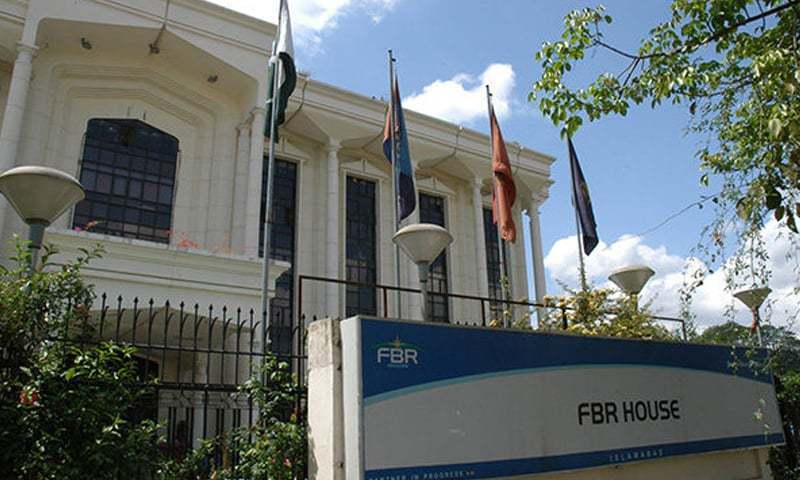
This file photo shows the Federal Board of Revenue in Islamabad. 

PESHAWAR: The Khyber Pakhtunkhwa Revenue Authority’s several cases of sales tax on services are stuck with courts with some pending decision for around five years, officials said.
KPRA director general Mohammad Nasir Khan told reporters here on Wednesday that there were around 20 cases wherein companies and businessmen had challenged the collection of sales tax on services in the Peshawar High Court.
He added that some of those cases had been awaiting verdict for since 2013.
KPRA chief says tax collection could surge to Rs30bn by 2023 if issues resolved
The litigant parties include the KP Bar Council, Contractors Association, PTCL, Chief Burger, Alliance Health Care and Rehman Medical Institute and other individuals.
He said the KPRA managed to collect Rs0.827 billion in construction and contracting services last year due to a stay order issued by the PHC in favour of the provincial contractors association and that it would have collected Rs2.11 billion as part of the last year’s annual development programme portion of civil works had those orders not been issued.
Mr Nasir said the authority set up in 2013 was ‘on track’ after the hiring of around 70 employees and that he was hopeful that the province’s sales tax collection would go up to Rs30 billion by 2023 if the pressing issues like litigation, staff and office shortage, and issues with the Federal Board of Revenue were resolved.
He however said compared to Sindh and Punjab, the size of KP’s economy was very small and that there was ‘ambivalence’ regarding the size of KP’s GDP, which was projected to 10 per cent of the country’s without any evidence on the ground.
“In hospitality sector, there’s a single top line hotel and nine multinational food chains in the province,” he said, adding that various surveys projected the provincial hospitality sector potential at Rs8 billion.
He said the KPRA was hopeful of collecting Rs500 million from the sector in 2018-19.
The KPRA chief said the province’s total contribution to the FBR and own taxes stood at Rs94 billion.
He said the authority was set up in 2013-14 and missed its revenue target for three consecutive years and that it was in 2016-17 when the authority managed to achieve its target.
Mr Nasir said the authority’s revenue collection in 2017-18 stood at Rs11 billion, while the suspension of taxes on mobile phone cards had also adversely impacted on their tax campaign.
A breakdown of figures shows that KP collected Rs5.27 billion from telecom sector, Rs1.1 billion as withholding tax, Rs725 million from banking and insurance sector and Rs3.81 billion from other sectors.
The KPRA chief said the FBR owed Rs1.92 billion to the KPRA during 2017-18 on account of ‘cross adjustment’.
He said soon after the KPRA’s establishment, the telecom sector accounted for almost all of its tax collection but that had come down to around 40 per cent implying that the province’s was diversifying its tax base.
Mr Nasir said currently, a huge area of the province was outside the tax net, which needed to be covered.
He said Malakand division accounted for 40 per cent of the province’s area and 25 per cent of population but it was a tax-free zone, while Hazara and southern parts of the province also contributed little to the tax net.
The KPRA chief said five central districts of KP, including Peshawar, Charsadda, Nowshera, Swabi and Mardan, which accounted for 10 per cent of area and 17 per cent of area, made the province’s whole economy.
He said the province’s urban immovable property tax collection amounted to Rs850 million, while around 70 per cent of it was collected from the provincial capital.
Mr Nasir said the PKRA had registered 4,700 people and was about to introduce the Restaurant Invoice Monitoring System in 20 restaurants of the provincial capital.
He said a tax facilitation centre had been established in Peshawar, while two were being set up in Abbottabad and Dera Ismail Khan.
Published in Dawn, September 27th, 2018
PHC again asks govt to respond to plea on Dr Shakil Afridi's ‘departure’

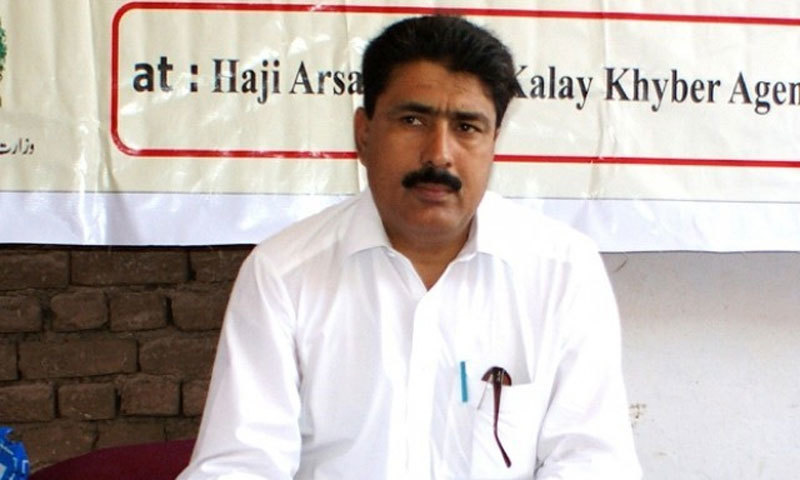
A file photo of Dr Shakil Afridi. 

PESHAWAR: A Peshawar High Court bench yet again sought comments from the interior secretary on Wednesday on a petition seeking its orders for the government against sending former agency surgeon of Khyber Agency Dr Shakil Afridi abroad in case of any secret deal with the US government.
Justice Qaiser Rasheed and Justice Ishtiaq Ibrahim heard preliminary arguments of the petitioner, Mohammad Khursheed Khan, who contended that any move by the government to shift Dr Shakil abroad would be unconstitutional and illegal.
The petitioner, who is a former deputy attorney general, pointed out that the court had earlier sought comments in May, but the respondent (interior secretary) had so far not filed them.
Petitioner seeks order for govt against sending former agency surgeon abroad under deal
The bench adjourned the hearing asking the interior secretary to file comments in the case. Schedule of the next hearing will be announced later.
Dr Shakil, a former agency surgeon of Khyber Agency, who was taken into custody in May 2011 on suspicion of helping the American CIA trace Al-Qaeda leader Osama bin Laden through a fake vaccination campaign in Abbottabad, was shifted few months ago to Rawalpindi’s Adiala Jail from Peshawar Central Prison, where he had been imprisoned since his conviction by an assistant political agent on the charge of having links with a banned militant outfit in 2012.
However, he was later shifted to Sahiwal Prison last month due to security reasons.
His shifting to Adiala Jail had also given birth to speculations including the one about his possible shifting abroad.
However, the Foreign Office had dispelled the impression in May that Dr Shakil would be shifted abroad as a result of any secret deal.
The petitioner requested the court to direct the government not to send Dr Shakil abroad until the disposal of the petition.
He prayed the court to declare that if Dr Shakil has to be sent abroad, the high court’s permission should be taken before it.
The petitioner had filed the petition last year after rumours surfaced that Dr Shakil might be sent abroad and handed over to the US government.
He claimed that he came to know that the adviser to the then prime minister on foreign affairs had said that if the US formally put up a request, then Pakistan could consider the handing over of Dr Shakil to the US.
The petitioner alleged that Dr Shakil had carried out a fake vaccination drive and had provided all the information to the Americans which had resulted into attack on Pakistan and killing of Osama bin Laden by them.
He said Dr Shakil was a convict who had brought bad name to the country and that the government had no legal authority to send a convict abroad.
The petitioner has also referred to the cases of Indian spy Kulbushan Yadev and American contractor Raymond Davis and said in those cases, the governments had succumbed to international pressure.
He said the government had failed to produce the evidence against Kulbushan before the UN to substantiate their case against India.
A petition of Dr Shakil against the upholding of his conviction by an appellate forum of the FCR Commissioner has been pending with the Fata Tribunal over three years without noteworthy progress.
The FCR Commissioner, which is the appellate forum under the FCR, had on Mar 15, 2014, had upheld the conviction of Dr Shakil for being linked to a banned militant organisation of Bara tehsil in Khyber Agency but reduced his original prison term slapped by the assistant political agent’s court from 33 years to 23 years and that of the Rs320,000 fine to Rs220,000.
Published in Dawn, September 27th, 2018
CPEC to change socioeconomic condition of GB people: Chinese ambassador

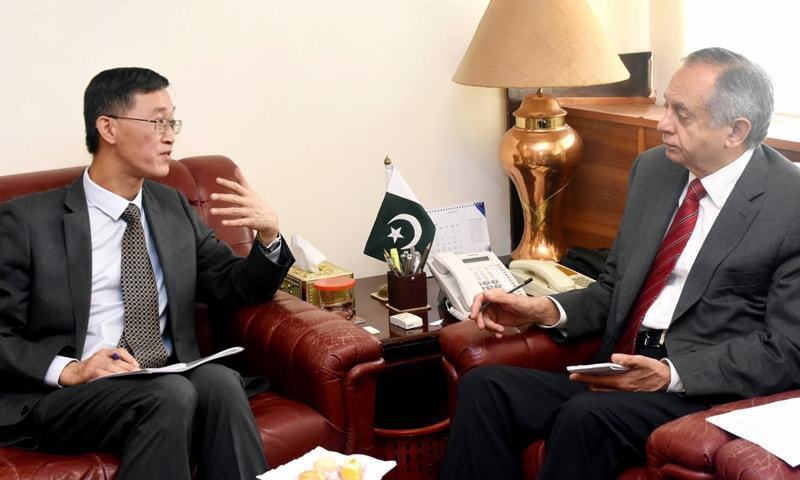
In this file photo China's ambassador Yao Jing meets the adviser to the Prime Minister on Commerce Abdul Razak Dawood earlier in September. 

GILGIT: Chinese Ambassador to Pakistan Yao Jing has said that the China-Pakistan Economic Corridor (CPEC) project will change the socioeconomic conditions of Gilgit-Baltistan people.
He said the project would provide trade, employment and education opportunities to the people of Pakistan in general and the GB in particular.
He stated these views while talking to Karakoram International University’s Vice Chancellor Prof Attaullah Shah and Dr Saranjam Baig, Director CPEC Centre set up at the varsity, who called on him at the Chinese Embassy in Islamabad the other day, according to a press release issued by the varsity on Wednesday.
The Chinese envoy said CPEC Centre would become a place for CPEC research. He assured the delegation to cooperate for further improving the performance of the centre. The varsity vice chancellor briefed the ambassador about the completed and ongoing activities at the CPEC Centre. He also highlighted the strategic importance of the varsity in the context of CPEC.
The meeting stressed the need for building a long-term partnership among the CPEC Centre, KIU, Chinese Embassy and other stakeholders. Possibilities regarding exchange programmes, research grants and partnerships with Chinese universities also came under discussion.
The vice chancellor also shared his plans to upgrade CPEC Centre into a Centre of Excellence. He invited the Chinese ambassador to visit KIU, which he accepted.
Ambassador Yao Jing shed light on how they were incorporating the social sector and less-developed regions into the CPEC in line with the vision of the new government.
He assured that the CPEC Centre would be provided with all possible assistance.
Published in Dawn, September 27th, 2018
5 takeaways from Pakistan's humbling Asia Cup exit

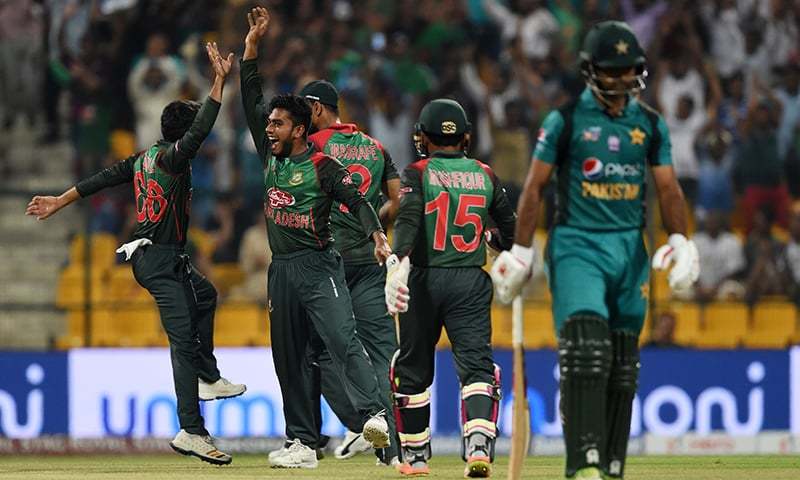
Bangladesh cricketer Mehidy Hasan Miraz (2L) celebrates with his teammates after he dismissed Pakistan batsman Fakhar Zaman (R) during the one day international (ODI) Asia Cup cricket match between Bangladesh and Pakistan at the Sheikh Zayed Stadium. — AFP 

Pakistan crashed out of the Asia Cup 2018 with a chastening 37-run defeat at the hands of Bangladesh on Wednesday. Here are our five takeaways from that disappointing campaign:

1- Let's keep knee-jerk reactions at a minimum

Heads should roll but not just to serve the public sentiment. — File

There is no doubting that the Asia Cup was probably the single most agonising event ever for Pakistan cricket. Within the span of a week, this team has gone from potential world cup winners to losing to Bangladesh. While whatever is broken in this team should be fixed, whatever isn't should be left alone.
Catastrophic failures in Pakistan cricket have often resulted in meaningless wholesale changes which sometimes weeds out the dead weight but also shelves assets. It is important that the PCB and the selection committee don't make changes just to serve the public sentiment.

2- Team's mental frailties come to the fore

They may have been a flaw or two with the squad composition, Sarfraz Ahmed may have made a few wrong calls, technique and temperament of some might have been questionable but all of this is dwarfed by the biggest, most glaring chink in the Pakistani armour: their mental frailties.
Barring one or two, the entire unit seemed to melt when the going got tough and the number of eyeballs on them increased. As explained here, Pakistani players' inability to handle this sort of pressure is aggravated by them not playing top sides or in empty UAE stadia. If the board is planning to work on something, this should be it.

3- Sarfraz's captaincy

Sarfraz's captaincy will come under scrutiny following his woeful form in the Asia Cup. — File

The biggest question facing the PCB will be whether or not to stick with Sarfraz's captaincy. The Champions Trophy-winning skipper has been woefully out of form with the bat and made some highly questionable batting-first decisions to go with poor team selections.
Furthermore, his ability to keep the teammates focused with his commentary from behind the wicket also backfired big time in Asia Cup as he came off with a ultra-critical leader who fails to lead by example but doesn't hesitate in delivering a tongue lashing in front of millions.
Having said that, this is probably the first time his captaincy and spot in the team have been questioned. With the World Cup next year, the PCB does not need to take any drastic decisions but they do need to sit Sarfraz down and have him understand the gravity of the situation.

4- The bunch that didn't make it

Experienced duo of Azhar and Hafeez were not picked for the Asia Cup. — AFP

Azhar Ali, Mohammad Hafeez, Wahab Riaz, Yasir Shah, Imad Wasim, Hussain Talat and Fawad Alam ... that's the best of the bunch that was left home in favour of those who humiliated themselves in the UAE.
Of the unpicked septet, Azhar and Hafeez were discarded this year for reasons unknown even though there seemed to be life left in them; Wasim had failed a Yo-Yo test although the jury is out on how effective such testing tools are for a not-so-athletic sport that cricket is; Shah isn't considered an ODI player even on spin-friendly UAE pitches, Talat was probably deemed too young and Fawad's case is no secret. Apart from Riaz, the remaining six can make a case for themselves, especially when the Asia Cup 2018 squad also had an untried, untested and frankly very ordinary looking Shan Masood.
Masood wasn't given a chance despite the top order failing throughout the event, which raises the question why he was even on the plane to the UAE. Have the media and fans been focusing on the wrong parchi? The Inzamamul Haq-led selection committee has some explaining to do.

5- Soul-searching needed but quick

Pakistan cricket team will have barely a few days of breather to recover from their mental, physical and emotional toll as the home series against Australia starts in 10 days. That series will be immediately followed by a similar one against New Zealand before the team leaves for South Africa later this year.
Asia Cup was the worst possible way to kick off a jam-packed schedule of almost five months of nonstop cricket against three of the world's most fearsome sides. Post-Asia Cup soul-searching will have to be done but quick.

Trump takes aim at China, Iran at UN Security Council

NEW YORK: US President Donald Trump opens the UN Security Council meeting on Wednesday.—AFP 

UNITED NATIONS: Pre­sident Donald Trump on We­­d­­nesday accused Iran of spreading chaos and China of meddling in US elections at a UN Security Council me­­e­ting that laid bare divisions between the United Sta­­tes and other world powers.
Presiding for the first time a meeting of the Uni­ted Nations’ body, Trump denounced the “horrible, one-sided” nuclear deal with Iran that he ditched in May, to the dismay of European allies.
A gavel-wielding Trump took a swipe at China, accusing Beijing of working aga­inst his Republican Party in upcoming midterm elections as payback for their growing trade war, a charge China’s foreign minister said was “unwarranted”.
Wednesday’s meeting highlighted a rift between the United States and its European allies over the Iran nuclear deal.
Trump vowed that re-imposed sanctions will be “in full force” and urged world powers to work with the United States to “ensure the Iranian regime changes its behaviour and never acquires a nuclear bomb”.
Addressing the council after Trump, French Presi­dent Emmanuel Macron hit back, declaring that concerns about Iran cannot be tackled with “a policy of sanctions and containment”. Also defending the deal that was endorsed in a Security Council resolution, British Prime Minister Theresa May said it “remains the best means of preventing Iran from developing a nuclear weapon”. The Uni­ted States has moved to reimpose sanctions that had been lifted under the 2015 deal to curb Iran’s nuclear programme and has vowed to punish foreign firms that do business with Iran.
Read: Laughter at Trump among a long line of shocking UN moments
Trump argued that since the deal was signed in 2015, “Iran’s aggression only increased” and that funds released from the lifting of sanctions had been used “to support terrorism, build nuclear capable missiles and foment chaos”.
Iran did not request to speak at the council meeting, but Iranian President Hassan Rouhani told a news conference that the United States would eventually rejoin the nuclear deal and pledged Tehran’s continued commitment to the accord.
“The United States of America one day, sooner or later, will come back. This cannot be continued,” Rouhani said.
Turning to Syria, Trump assailed Russia and Iran for backing President Bashar al-Assad in his brutal war in Syria, saying: “The Syrian regime’s butchery is enabled by Russia and Iran.”
China’s Foreign Minister Wang Yi stressed that the “rights of all countries to trade with Iran should be respected” after the European Union said a special payment system would be set up to keep alive business ties with Iran.
In a blunt attack on China, Trump told the council that China wanted to see him suffer an elections setback because of his hard line on trade.
“Regrettably we found that China has been attempting to interfere in our upcoming 2018 election coming up in November against my administration,” he said. “They do not want me or us to win because I am the first president ever to challenge China on trade.”
The Republicans could lose control of both the Senate and House of Rep­res­en­ta­t­i­ves in November’s elections, further imperiling Trump’s chances of chalking up legislative achievements.
The Chinese foreign minister responded flatly that Beijing strictly adhered to a policy of non-interference. “We did not and will not interfere in any country’s domestic affairs. We refuse to accept any unwarranted accusations against China,” said Wang.
Tensions have soared bet­ween Beijing and Washing­ton after Trump this week slapped new tariffs covering $200 billion in Chinese go­­ods exported to the United States.
On North Korea, Trump called for sanctions to be str­­ictly enforced against Pyongyang — a message directed at Russia and China which are pushing for an easing of punitive measures to reward North Korean leader Kim Jong-un.
Without naming countries, the US president noted that “some nations are already violating UN sanctions” including illegal ship-to-ship transfers of oil and said compliance was “very important”.
His comments came shortly before his top diplomat, US Secretary of State Mike Pompeo, signalled on Wednesday that he would return to North Korea next month to push forward denuclearisation talks.
It was only the third time in UN history that a US president chaired a Security Council meeting. Barack Obama presided over two meetings in 2009 and 2014.
Published in Dawn, September 27th, 2018